In everyday conversations within the electrical and engineering space, the terms “transformer” and “power supply” are often used interchangeably. While they are closely related and frequently work together in electrical systems, they are not the same thing. Understanding the difference between transformers and power supplies is essential for engineers, technicians, facility managers, manufacturers, and business owners who rely on stable and efficient electrical systems.
At Just HardRich Global Resources Limited, Nigeria’s choicest Electrical Power and Control Engineering Company, we encounter this confusion regularly when consulting on industrial installations, commercial power systems, automation projects, and electrical maintenance solutions. Selecting the wrong component – or misunderstanding its role – can lead to inefficiency, equipment damage, safety risks, and unnecessary costs.
This in-depth guide explains the true differences between transformers and power supplies, how they work, where they are used, current industry trends, and how to choose the right solution for your application.
What Is a Transformer?
A transformer is a passive electrical device designed to transfer electrical energy between two or more circuits using electromagnetic induction. Its primary purpose is to change AC (alternating current) voltage levels – either increasing (stepping up) or decreasing (stepping down) voltage – without altering the frequency.
Transformers operate only on AC power. This is because their functionality depends on a continuously changing magnetic field, which does not exist in direct current (DC).
Key Characteristics of Transformers
- Works exclusively with alternating current (AC)
- Changes voltage levels, not current type
- Does not convert AC to DC
- Highly efficient with minimal power loss
- Essential for power transmission and distribution
At Just HardRich Global Resources Limited, transformers are a critical component in many of the industrial, commercial, and utility-scale electrical systems we design, install, and maintain across Nigeria.
How Transformers Work
The operation of a transformer is based on Faraday’s Law of Electromagnetic Induction. When an alternating voltage is applied to the primary winding, it produces a changing magnetic field in the transformer’s core. This fluctuating magnetic field then induces a voltage in the secondary winding.
Main Components of a Transformer
- Primary Winding – Receives the input AC voltage
- Secondary Winding – Delivers the output AC voltage
- Magnetic Core – Usually made of laminated silicon steel to reduce losses
The ratio of turns between the primary and secondary windings determines whether the transformer steps voltage up or down.
Step-Up Transformers
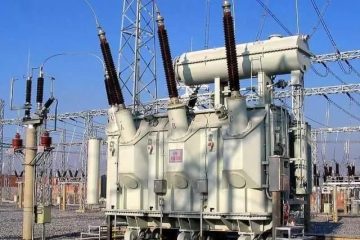
A step-up transformer increases voltage from the primary side to the secondary side.
Common Uses
- Power generation stations
- High-voltage transmission lines
- Renewable energy systems (solar farms and wind installations)
In Nigeria, step-up transformers play a vital role in minimizing transmission losses when electricity travels long distances from power plants to substations.
Step-Down Transformers
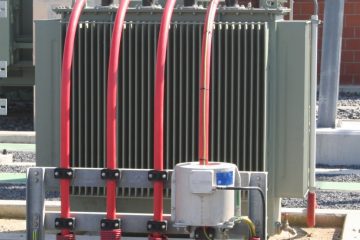
A step-down transformer reduces voltage to safer and more usable levels.
Common Uses
- Distribution substations
- Industrial facilities
- Residential and commercial buildings
- Control panels and automation systems
Just HardRich Global Resources Limited frequently installs and services step-down transformers in factories, hospitals, office complexes, estates, and data centers, ensuring voltage stability and equipment protection.
Applications of Transformers in Modern Electrical Systems
Transformers form the backbone of Nigeria’s electrical infrastructure. Without them, power transmission at scale would be inefficient and unsafe.
Common Applications Include:
- National grid transmission and distribution
- Manufacturing plants and heavy industries
- Oil and gas facilities
- Mining operations
- Renewable energy systems
- Electrical substations and switchyards
In many modern systems, transformers are also integrated into smart grids, enabling improved monitoring, fault detection, and load management—an area where innovative engineering solutions are becoming increasingly important.
What Is a Power Supply?
A power supply, often referred to as a Power Supply Unit (PSU), is a more complex electrical device that converts electrical power from one form to another. Most commonly, it converts AC power from the mains into regulated DC power required by electronic devices and control systems.
Unlike a transformer, a power supply is not a single component, but a complete system made up of multiple stages that work together to deliver clean, stable, and safe power.
Power supplies can be:
- External (laptop chargers, adapters)
- Internal (desktop computers, industrial control panels)
How a Power Supply Works
A typical linear power supply operates through a multi-stage process:
1. Transformer Stage
The transformer reduces the incoming high-voltage AC (e.g., 220–240V in Nigeria) to a lower AC voltage suitable for electronics.
2. Rectifier Stage
The rectifier converts AC into pulsating DC, usually using diode bridges.
3. Filtering Stage
Capacitors smooth out voltage ripples, producing a more stable DC output.
4. Voltage Regulation Stage
The regulator ensures a constant voltage output, protecting sensitive components from fluctuations.
Modern switch-mode power supplies (SMPS) improve efficiency, reduce size, and handle voltage variations better – making them ideal for today’s fast-evolving industrial and automation environments.
Applications of Power Supplies
Power supplies are essential wherever electronic control, precision, and automation are required.
Common Applications Include:
- Computers and communication systems
- Industrial automation and PLC panels
- CNC machines and robotics
- Medical and laboratory equipment
- Telecommunication infrastructure
- Renewable energy inverters
- Smart control and monitoring systems
At Just HardRich Global Resources Limited, we design, integrate, and maintain industrial-grade power supply systems that support reliable operations in manufacturing, healthcare, and critical infrastructure.
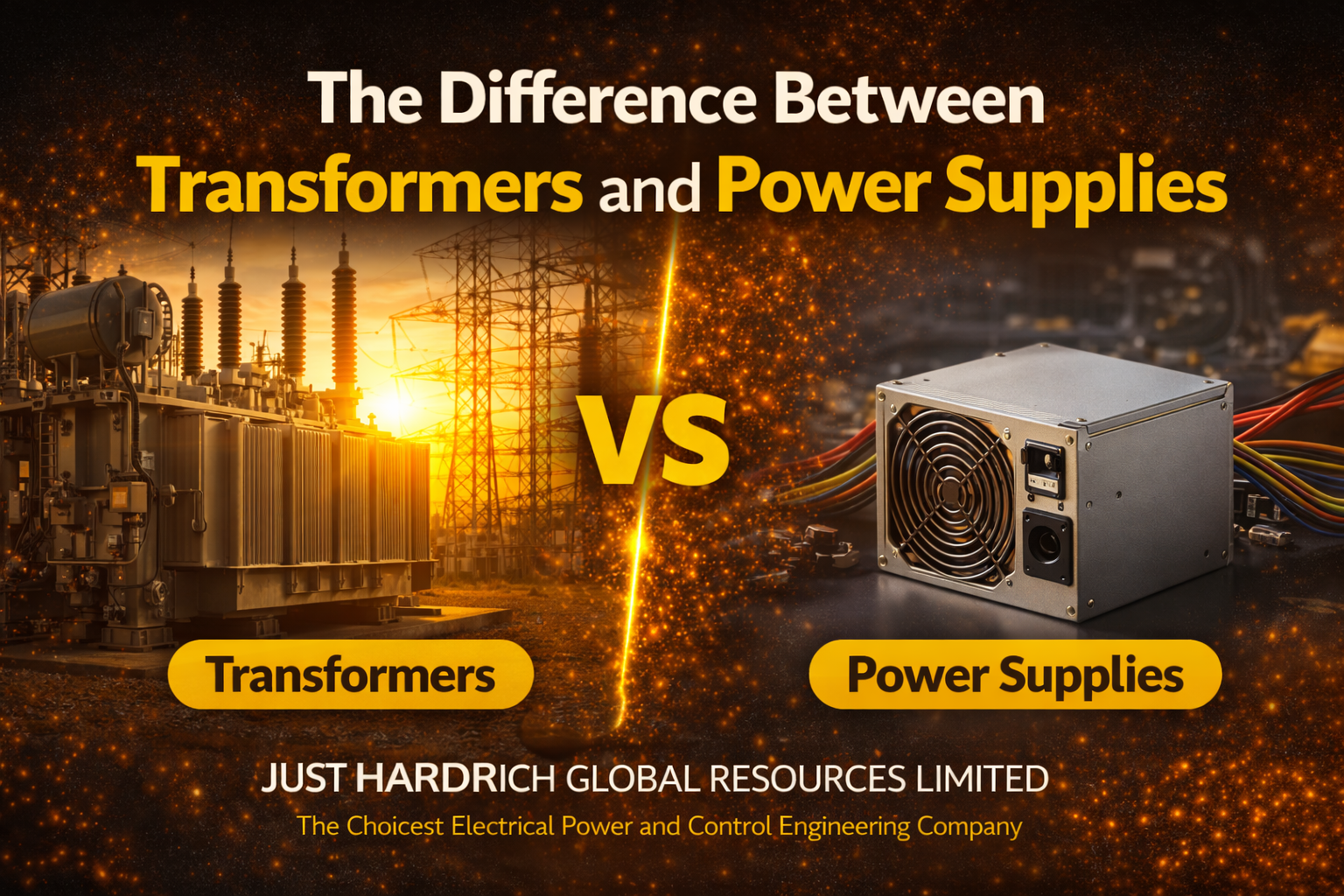
Transformer vs. Power Supply: The Key Differences
| Aspect | Transformer | Power Supply |
|---|---|---|
| Primary Function | Changes AC voltage | Converts AC to regulated DC |
| Complexity | Simple | Complex system |
| Output Type | AC | DC |
| Components | Windings & core | Transformer, rectifier, filter, regulator |
| Usage | Power transmission & distribution | Electronics & control systems |
The Bottom Line
A transformer is a building block, while a power supply is a complete solution. You cannot power DC equipment with a transformer alone, and a power supply almost always relies on a transformer (or switching circuitry) to function effectively.
Emerging Trends and Innovative Tools in Power Engineering
The electrical power industry is evolving rapidly, and Nigeria is no exception.
Key Trends Include:
- Smart transformers with embedded sensors
- Energy-efficient power supplies with low standby losses
- Digital monitoring and diagnostics
- Integration with IoT and automation systems
- Renewable energy-compatible power systems
At Just HardRich Global Resources Limited, we stay ahead by adopting modern diagnostic tools, advanced testing equipment, and smart engineering practices to deliver future-ready solutions.
Practical Tips for Choosing the Right Solution
- Identify your load requirements (AC or DC)
- Understand voltage and current needs
- Consider efficiency and long-term operating costs
- Account for environmental conditions
- Work with experienced professionals
Improper selection can result in overheating, downtime, or complete system failure – risks no business can afford.
Why Just HardRich Global Resources Limited Is the Right Partner
As the choicest Electrical Power and Control Engineering Company in Nigeria, Just HardRich Global Resources Limited delivers:
- Expert consultation and system design
- Transformer installation, maintenance, and testing
- Industrial and commercial power supply solutions
- Electrical control and automation services
- Preventive maintenance and fault diagnostics
Our solutions are tailored to Nigeria’s unique power challenges, ensuring reliability, safety, efficiency, and long-term value.
Final Thoughts
Understanding the difference between transformers and power supplies is not just academic – it is practical, strategic, and essential for modern electrical systems. While transformers manage voltage levels, power supplies ensure electronic systems receive clean, stable DC power.
Whether you are powering an industrial facility, automating a production line, or upgrading electrical infrastructure, Just HardRich Global Resources Limited stands ready to deliver dependable, innovative, and professional power engineering solutions.