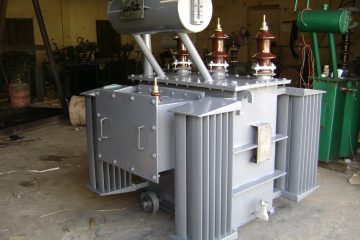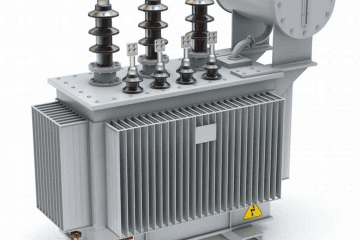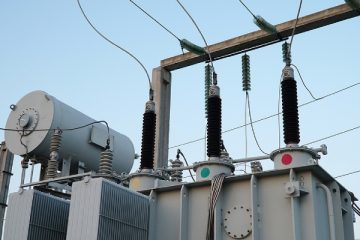
Power transformers are among the most valuable and long-lasting assets in any electrical power system. From substations and manufacturing plants to hospitals, estates, and data centers, transformers quietly perform the critical task of voltage regulation and power stability. However, a transformer’s reliability and efficiency do not depend on a single event – they are shaped across a carefully managed lifecycle that can span 30 to 50 years or more.
At Just HardRich Global Resources Limited, widely regarded as the choicest Electrical Power and Control Engineering Company, we understand that transformer performance is not accidental. It is the result of informed design decisions, professional installation, disciplined operation, and strategic maintenance. For businesses, utilities, and industries across Nigeria, understanding the lifecycle of a transformer is essential for asset protection, safety, cost control, and long-term power reliability.
This comprehensive guide explains each stage of a transformer’s lifecycle – from planning and design to retirement and replacement – using practical examples relevant to Nigerian operating environments.
Understanding the Key Stages in the Transformer Lifecycle
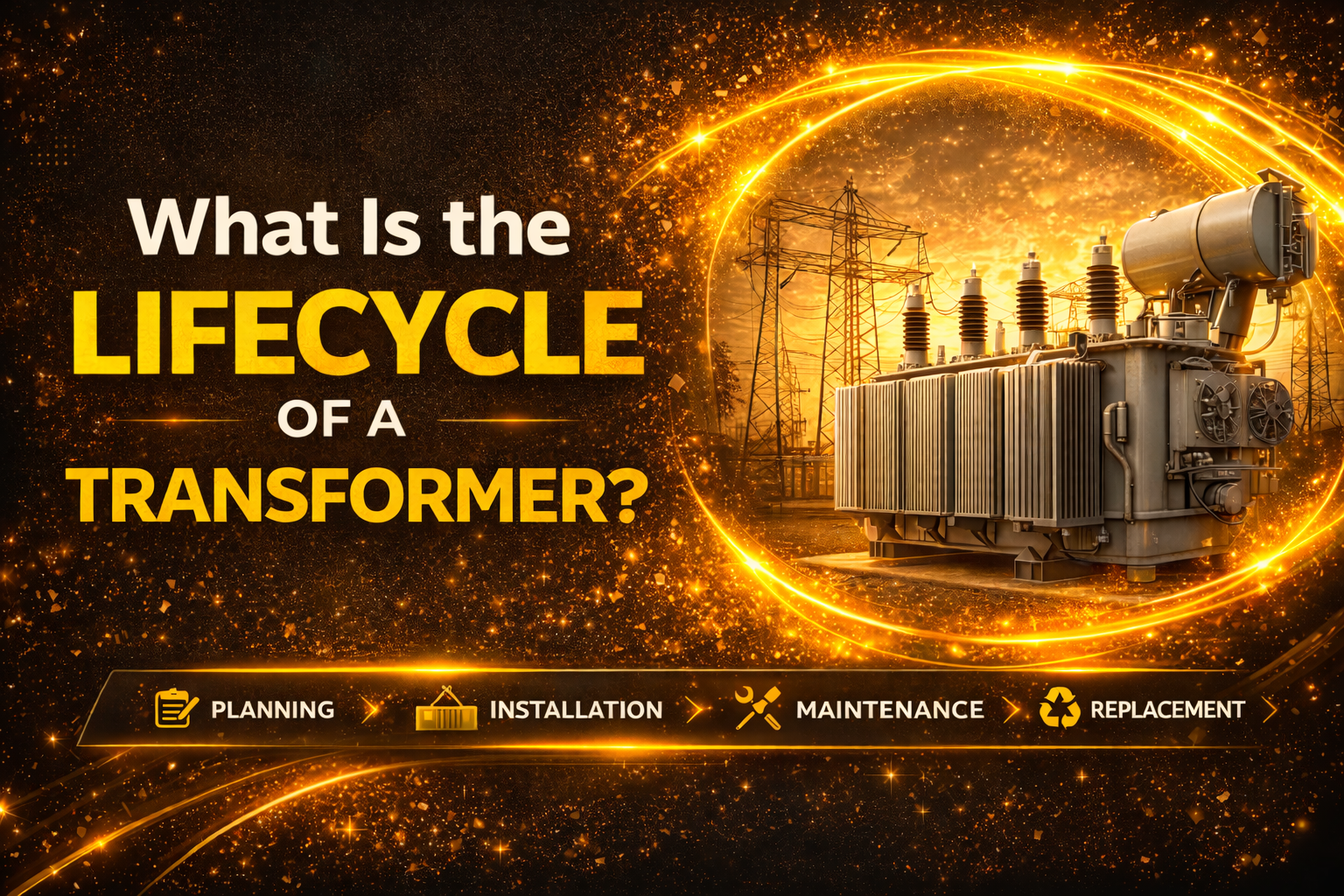
A transformer’s lifecycle is a continuous journey rather than a single event. Each stage influences efficiency, lifespan, operating cost, and risk exposure.
The main stages include:
- Planning and specification
- Design and engineering
- Manufacturing and factory testing
- Transportation, installation, and commissioning
- Operation and routine maintenance
- Aging management, upgrades, and life extension
- Decommissioning and replacement
One critical truth often overlooked is this: most transformer failures are predetermined at the early stages. Decisions made before installation often define how well a transformer performs decades later. This is why Just HardRich Global Resources Limited places strong emphasis on lifecycle-based engineering rather than short-term fixes.
Planning and Specification: Where the Lifecycle Truly Begins
The lifecycle of a transformer begins long before it arrives on site. During planning, electrical demand, system constraints, and future expansion are evaluated.
At this stage, professionals assess:
- Present and projected load demand
- Voltage levels and power quality requirements
- Environmental conditions such as heat, humidity, and dust
- Space availability and safety considerations
- Applicable Nigerian and international standards (IEC, IEEE)
In Nigeria, common planning errors include undersizing transformers, ignoring ambient temperature effects, and failing to account for load growth. These mistakes often lead to early overheating, excessive losses, and premature insulation failure.
At Just HardRich Global Resources Limited, we conduct detailed load analysis and future-proof planning to ensure transformers are neither overstressed nor inefficiently oversized.
Design and Engineering: Shaping Long-Term Performance
Once specifications are clear, detailed engineering begins. This stage determines how efficiently the transformer will operate and how well it will age.
Key design considerations include:
- Core material selection to minimize no-load losses
- Winding configuration to reduce copper losses
- Thermal design to control hot-spot temperatures
- Insulation system strength and moisture resistance
- Mechanical robustness against short-circuit forces
In hot climates like Nigeria, thermal design is especially critical. Poor thermal margins accelerate insulation aging, leading to early failure. Just HardRich Global Resources Limited prioritizes conservative thermal designs that withstand high ambient temperatures and unstable grid conditions.
Modern transformer design also incorporates:
- Low-loss amorphous or high-grade silicon steel cores
- Improved insulation materials with higher thermal endurance
- Digital modeling tools to simulate load and temperature behavior
These innovations help reduce operating losses and extend service life.
Manufacturing and Factory Testing: Turning Design into Reality
Manufacturing quality plays a decisive role in transformer lifespan. Even the best design can fail if production standards are compromised.
During manufacturing:
- Cores are precisely cut, stacked, and clamped
- Windings are carefully formed with controlled tension
- Insulation is applied under strict cleanliness conditions
- Units are dried and impregnated to remove moisture
- Oil is filled under vacuum for oil-immersed transformers
Factory testing is equally critical. Routine and type tests verify:
- Electrical losses and efficiency
- Insulation integrity
- Impedance and voltage ratios
- Dielectric strength and thermal performance
At Just HardRich Global Resources Limited, we emphasize factory acceptance testing (FAT) as a non-negotiable step. Testing identifies defects early, preventing hidden issues that could surface years later in service.
Transportation, Installation, and Commissioning: Protecting the Asset
A transformer’s journey from factory to site is one of the most vulnerable stages in its lifecycle.
Transportation risks include:
- Mechanical shock and vibration
- Moisture ingress
- Misalignment of internal components
Professional handling, shock monitoring, and proper packaging are essential. Once on site, installation quality determines whether the transformer starts life under optimal conditions.
Installation involves:
- Proper foundation alignment
- Accurate positioning and anchoring
- Correct assembly of bushings, radiators, and accessories
- Reliable earthing and protection integration
Commissioning follows installation and includes:
- Insulation resistance testing
- Ratio and polarity checks
- Cooling system verification
- Controlled energization
At Just HardRich Global Resources Limited, commissioning is treated as a strategic milestone, not a formality. We ensure baseline performance data is recorded, forming the reference point for future condition monitoring.
Operation and Maintenance: The Longest Lifecycle Stage
The operational phase is where transformers either fulfill their potential or deteriorate prematurely. This stage often lasts several decades.
Good operational practices include:
- Maintaining load within design limits
- Avoiding prolonged overloading
- Managing voltage fluctuations
- Reducing harmonics from nonlinear loads
Maintenance focuses on preserving insulation health and cooling efficiency.
Routine activities include:
- Visual inspections for leaks, corrosion, or noise
- Oil testing and dissolved gas analysis (DGA)
- Temperature and load trend monitoring
- Cooling system servicing
Just HardRich Global Resources Limited increasingly deploys condition-based maintenance using modern diagnostic tools. Online monitoring systems now allow operators to detect early warning signs before failures occur – an emerging trend across Nigeria’s power and industrial sectors.
Aging, Upgrades, and Life Extension Strategies
No transformer ages at a fixed rate. Some reach end-of-life early, while others operate reliably for decades beyond expectations.
Key aging factors include:
- Thermal stress
- Moisture contamination
- Electrical surges and faults
- Environmental exposure
When aging becomes evident, life-extension options may be considered:
- Oil regeneration and insulation drying
- Cooling system upgrades
- Tap changer refurbishment
- Installation of digital monitoring systems
These interventions can add 10–20 years of useful life when properly applied. At Just HardRich Global Resources Limited, we assess technical condition alongside economic viability before recommending refurbishment or replacement.
Decommissioning and Replacement: Knowing When to Let Go
Eventually, a transformer reaches a point where continued operation is no longer safe or economical.
Replacement is triggered by:
- Severe insulation degradation
- Repeated failures or overheating
- Rising losses exceeding efficiency standards
- Inability to meet growing load demand
Decommissioning is carefully planned to avoid outages and environmental harm. Oil is treated or recycled, valuable materials such as copper and steel are recovered, and environmental regulations are strictly followed.
Modern replacement transformers offer:
- Lower losses
- Higher efficiency
- Smart monitoring capabilities
- Better compatibility with evolving power systems
Timely replacement, guided by lifecycle analysis, prevents emergency failures and costly downtime.
The Role of Just HardRich Global Resources Limited in Transformer Lifecycle Management
Across Nigeria, Just HardRich Global Resources Limited stands out as the choicest Electrical Power and Control Engineering Company, offering end-to-end transformer lifecycle solutions.
Our services include:
- Transformer specification and procurement support
- Professional installation and commissioning
- Preventive and predictive maintenance
- Condition assessment and life-extension solutions
- Upgrade, replacement, and decommissioning services
By adopting a lifecycle-based approach, we help clients reduce total cost of ownership, improve power reliability, and protect long-term investments.
Conclusion
The lifecycle of a transformer is a long, complex journey that spans planning, design, manufacturing, installation, operation, maintenance, and eventual replacement. Each stage plays a vital role in determining reliability, efficiency, and overall value.
Organizations that understand and actively manage this lifecycle enjoy:
- Fewer unplanned outages
- Lower maintenance and energy costs
- Extended asset life
- Improved safety and compliance
With the right technical partner, transformers are not just equipment – they are long-term assets. Just HardRich Global Resources Limited remains committed to helping Nigerian industries, utilities, and businesses maximize transformer performance throughout every stage of its lifecycle.